
Mission Persistence in Multi-Drone Operations: The Critical Role of Advanced RF Interconnect Architecture
By Maria Giudetti, Director – International Market Development
Originally published with microwavejournal.com
 Modern military operations are entering an era defined not by a single dominant platform but by coordinated fleets of unmanned systems operating as distributed networks. Multi-drone deployments—executing swarm tactics, distributed intelligence, surveillance, and reconnaissance (ISR), electronic warfare (EW), communications relay, and decoy operations—are redefining how battlespace awareness and influence are achieved. In these architectures, mission success depends not only on advanced sensors, autonomy algorithms, and secure data links, but on the reliability of the RF interconnect infrastructure that binds every subsystem together.
In multi-drone operations, connectivity is not a static design consideration; it is a dynamic structural requirement. Each UAV becomes a node in a broader RF ecosystem, operating under continuous mechanical stress, thermal variation, and electromagnetic congestion. Interconnect assemblies are no longer passive signal paths. They are mission-enabling components that must preserve RF integrity under high-duty cycles, high-frequency operation, and harsh operational conditions.
Multi-Drone Military Operations: Connectivity as a Combat Enabler
Multi-drone systems offer inherent advantages in resilience and adaptability. Swarm tactics distribute sensing and strike capability across multiple platforms, reducing vulnerability and increasing redundancy. Coordinated ISR missions rely on synchronized data flow to build a cohesive operational picture, while EW operations depend on tightly controlled timing relationships between distributed emitters and receivers.
These operational requirements create specific challenges at the physical layer, where cable and connector performance directly impacts mission capability. As payload complexity increases, the number of RF paths within each UAV grows accordingly, with high-frequency radar, SATCOM, global navigation satellite system (GNSS), and data links operating in close proximity within tightly packed enclosures.
Physical Constraints
Composite airframe limitations
Unlike traditional metallic airframes, composite structures do not inherently contain or attenuate electromagnetic energy. This shifts the burden of EMI containment to the interconnect system, requiring robust shielding architectures and disciplined grounding strategies: high-coverage braided or foil shields (often both), 360° shield terminations at connectors (no pigtails), and shield continuity across the entire signal path, including through bulkheads.
Mechanical environment
Continuous vibration, maneuvering loads, and frequent payload swaps subject cables to repeated flexure and mechanical strain. This can alter electrical length, compromise shielding integrity, and fatigue cable-to-connector transitions over time. In modular UAV platforms, repeated mating cycles and reconfiguration increase the risk of mechanical wear that degrades long-term RF stability.
Dense packaging
With multiple RF systems operating side-by-side in tight mechanical envelopes, several coupling mechanisms become more pronounced: near-end (NEXT) and far-end (FEXT) crosstalk injects noise from aggressor lines into victim lines, especially at high edge rates; shared return paths allow noise currents from one circuit to modulate another; and reduced spacing turns traces into unintended antennas, both emitting and receiving interference. Variations in spacing, dielectric, or reference planes make it harder to maintain consistent characteristic impedance.
Multi-Drone Military Operations: Connectivity as a Combat Enabler
Insertion loss sensitivity
At higher frequencies, signal wavelengths shrink, making features that once seemed negligible—such as millimeters of routing variation, slight connector misalignment, and subtle dielectric changes—now represent a meaningful fraction of a wavelength. Insertion loss increases sharply due to conductor surface roughness (skin effect dominates), dielectric loss tangent, and connector transitions and plating quality. Even small degradations accumulate quickly, reducing signal amplitude and directly impacting link budget, which in radar translates to reduced detection range and in SATCOM and data links to lower throughput or higher error rates.
Impedance discontinuities
Steps in connector interfaces, cable-to-board transitions, and tight bends create reflections that distort the signal, introduce standing waves, and reduce power transfer efficiency. Tight or inconsistent bends change the effective dielectric distribution and distort the field inside the cable, locally altering impedance. Connector transitions at microwave and millimeter-wave frequencies are often the weakest link: misalignment or wear increases return loss, poor launch design creates mode conversion and radiation, and repeated mating cycles degrade performance over time.
Phase stability
Tiny changes in electrical length, from temperature, bend radius, or mechanical stress, shift phase. In phased-array radar or GNSS systems, phase errors degrade beamforming accuracy or positioning precision. Even repeatability, how a cable behaves after installation or vibration, matters as much as nominal performance, especially in tightly packed enclosures where routing compromises are common.
System-Level Impact
High channel counts in distributed sensing and coordinated EW operations demand precise timing and signal consistency across multiple channels. Even small amplitude imbalance or phase drift between cable assemblies degrades mission effectiveness:
- Amplitude imbalance skews weighting across elements, distorting beam patterns and reducing gain
- Phase error directly corrupts steering vectors, degrading pointing accuracy and null placement
- Group delay variation impacts timing alignment, especially in wideband systems
These effects compound. A few degrees of phase drift or fractions of a dB mismatch per channel can collectively broaden beams, raise sidelobes, and reduce interference suppression effectiveness. For EW and distributed sensing, that translates into reduced detection sensitivity, poorer geolocation accuracy, and weaker jamming effectiveness.
Maintaining low insertion loss, consistent impedance, and high shielding effectiveness across densely packed systems requires careful evaluation of cable routing, connector transitions, grounding strategies, and shielding termination methods to prevent unwanted coupling and EMI propagation. Lightweight, SWaP-optimized cable assemblies such as those used in UAV-specific architectures support these constraints by reducing diameter and mass while maintaining electrical performance. Modern UAV interconnect solutions address these tradeoffs through advanced dielectric formulations, precision shielding braids, and carefully engineered transitions that preserve electrical continuity without compromising RF integrity.
Engineering for Harsh and Dynamic Environments
Multi-drone deployments extend across some of the most demanding environments on Earth. Arctic cold, desert heat, maritime salt fog, high-altitude pressure differentials, and persistent vibration all impose simultaneous electrical and mechanical stresses.
Thermal cycling can alter dielectric constants, affecting impedance and phase velocity. Differential expansion between conductors and dielectric materials can introduce mechanical stress, potentially impacting long-term reliability. Continuous vibration and maneuvering loads can fatigue conductor materials or strain cable-to-connector transitions. Salt-laden environments accelerate corrosion, while sand and dust intrusion threaten sealing integrity.
For UAV platforms, these stresses are magnified by size constraints and weight sensitivity. Interconnect assemblies must function not only as signal carriers, but as mechanically robust elements that withstand dynamic flexure without degrading performance. Flexure-induced phase change becomes particularly relevant in applications involving beam steering or synchronized EW transmission.
Emerging material technologies are supporting these requirements. Lightweight conductive fiber constructions offer opportunities to reduce harness mass while maintaining shielding effectiveness and mechanical durability. Advanced jacket materials such as ETFE provide flexibility across wide temperature ranges, supporting both cold-weather performance and high-temperature resilience.
“In UAV platforms, cable assemblies experience repeated bending, exposure to temperature variation, and sustained vibration,” notes Chris Cooper, Director of Engineering. “Designing for durability means understanding how mechanical strain translates into electrical change, and engineering solutions that mitigate that interaction.”
RF Integrity and Phase Stability in Distributed Architectures
Phase stability is especially critical in multi-drone operations that incorporate radar, EW, or distributed sensing technologies. Phased-array systems and coordinated EW deployments depend on precise timing relationships between signal paths. Even small variations in phase due to temperature shifts or mechanical flexure can degrade targeting accuracy, reduce beam coherence, or introduce synchronization errors across the swarm.
Phase change is influenced by dielectric stability, conductor expansion coefficients, mechanical strain, and overall cable construction symmetry. In dynamic UAV environments where cable routing may experience repeated flexure, maintaining consistent electrical length becomes a significant engineering challenge.
Phase-stable micro coaxial cable assemblies are engineered specifically to address these conditions. By carefully controlling foam-core dielectric formulations and conductor geometry, these cables minimize phase variation across wide temperature ranges while maintaining flexibility. Originally developed for demanding applications such as satellite programs, these low-loss technologies now support a broad frequency range in airborne and unmanned platforms.

InstaBend® Phase Stable microwave cable assemblies exemplify this approach. Designed to connect RF circuit cards, modules, and enclosure panels in space-constrained environments, these flexible assemblies support low-profile bends while maintaining stable electrical performance.
“Phase stability is a critical and yet often overlooked parameter in all RF systems.” explains Chris Cooper. “Vibration‑induced microphonics can add phase noise and degrade system sensitivity, while violating bend‑radius limits can compress the dielectric, alter permittivity and impedance and ultimately cause phase distortion.”
Modular UAV Design and Rapid Mission Reconfiguration
Modern UAV platforms increasingly incorporate modular design principles, enabling rapid payload swaps and mission reconfiguration. Line-replaceable units (LRUs) support multi-mission flexibility, allowing a single airframe to transition between ISR, communications relay, EW, or counter-UAS roles.
This modularity places additional demands on interconnect systems. Connectors must support blind-mate engagement, high mating cycles, and mixed-signal integration while maintaining sealing integrity and impedance continuity. Cable assemblies must tolerate repeated installation and removal without degrading shielding performance or mechanical robustness.
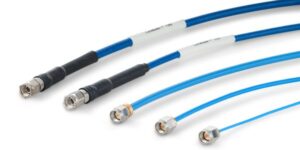
SWaP-optimized UAV interconnect solutions—such as Levitate® assemblies engineered for lightweight airborne applications—enable this adaptability. Flexible, compact assemblies simplify routing between modular components and reduce strain at termination points. Levitate cable’s phase-stable technology addresses the dual challenge of mechanical resilience and electrical consistency: its construction maintains phase stability under flexure and vibration while supporting the repeated mating cycles that modular platforms demand.
When cable and connector transitions are engineered as an integrated system, impedance discontinuities and mechanical weak points are minimized. This integrated approach aligns with the broader shift from component-level sourcing to system-level interconnect engineering. Rather than treating cables and connectors as discrete hardware, manufacturers increasingly design complete RF transmission paths as unified assemblies, optimizing the entire signal chain from launch to termination. This strategy improves repeatability, simplifies installation, and enhances lifecycle durability in rapidly evolving UAV fleets.
Advanced Materials, Manufacturing Discipline, and Qualification
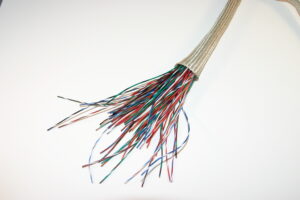
Reliability in multi-drone systems begins with disciplined materials engineering and manufacturing control. Precision conductor fabrication, tightly controlled dielectric extrusion, and optimized shielding architecture all contribute to predictable insertion loss, impedance stability, and phase performance. Advanced materials such as ARACON® high-strength conductive fiber, enable consistent electrical performance across wide frequency ranges while maintaining the mechanical flexibility required for dense UAV routing.
Factory-terminated assemblies enhance repeatability by eliminating variability introduced during field termination. Controlled crimping, soldering, and sealing processes ensure consistent electrical and mechanical characteristics across production runs. In high-frequency UAV applications, even minor deviations at cable-to-connector transitions can introduce reflections that degrade signal-to-noise ratio and reduce effective range.
Corrosion-resistant platings and vapor-sealed constructions protect against environmental degradation, particularly in maritime or high-humidity deployments. As UAV missions extend in duration and geographic scope, validated environmental performance becomes increasingly important
“Qualification testing provides confidence that assemblies will perform beyond laboratory conditions,” states Chris Cooper. “Thermal cycling, vibration, and environmental exposure testing reveal how designs behave under the stresses that real UAV platforms encounter daily.”
From Connectivity to Mission Persistence
The expansion of multi-drone military operations represents more than a tactical evolution; it signals a transformation toward distributed, synchronized, and frequency-intensive defense architectures. In these systems, interconnect performance directly influences radar accuracy, communications range, EW effectiveness, and overall mission endurance.
Technologies such as SWaP-optimized UAV cable assemblies, phase-stable micro coaxial designs, and lightweight conductive fiber constructions are enabling infrastructure for distributed, high-frequency, and mechanically dynamic platforms. Solutions engineered with system-level integration in mind including ARACON fiber for EMI shielding, Levitate ultra-lightweight cable assemblies, and InstaBend phase-stable solutions demonstrate how interconnect innovation supports both weight reduction and precision RF performance in modern UAV fleets.

As UAV fleets scale and coordinated operations become more sophisticated, the demands on RF interconnect architecture will continue to intensify. Higher frequencies, denser electromagnetic environments, and greater autonomy will amplify the need for phase stability, shielding effectiveness, mechanical resilience, and disciplined system integration.
In this evolving space, advanced interconnect engineering is not a supporting afterthought; it is foundational infrastructure, enabling the synchronized performance and long-term reliability that next-generation multi-drone military operations require.
Subscribe Now!
Interested in receiving email newsletters and other updates from Micro-Coax? Subscribe to receive our quarterly newsletter, product updates and more.